Hello readers! We’ve been away for a bit. But Norm and I have been working on something new. Hopefully I’ll have a cover image to reveal in the next month.
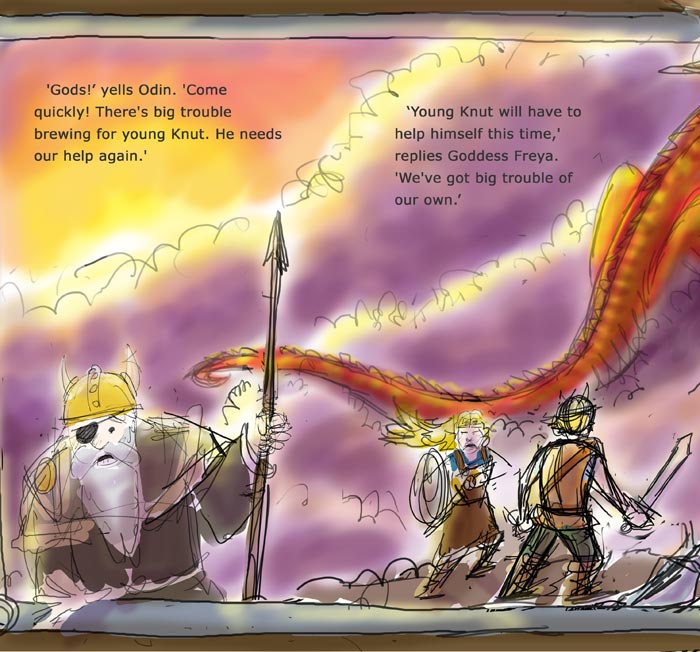
In the meantime, here’s a section from one of my colour roughs. It should give you a little idea of what’s to come.
Yesterday, Peter Jeffery from 95.3fm interviewed myself and talented fellow Fremantle Press author/illustrator Sean E Avery about making a living as children’s book illustrators. Click below to hear the interview.
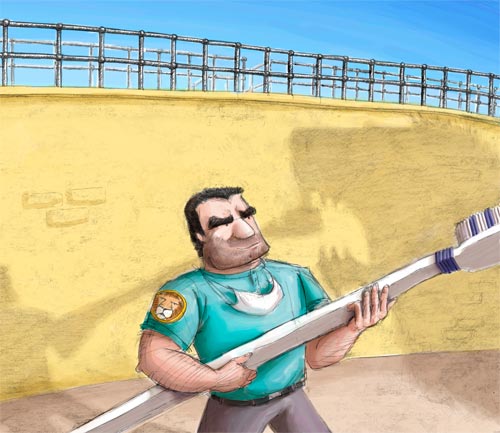
I’ve just finished the illustrations for a new children’s book that I wrote a while back. It’s called ‘In The Lion’ and will be published by Walker Books in the second half of 2012. It’s a black comedy for kids and that’s all I’ll say for now… I’ll put some more info on the homepage throughout 2012- in the meantime, here’s a little sneak peek.
There’s a scene in Last Viking where Josh arrives at Nan and Pop’s house, says goodbye to his mum and dad, and watches them drive off. Sounds simple enough. It took Norm and I a few goes to get it right.
The text and pictures would have to achieve a number of things- introduce Nan and Pop, introduce the setting, and show Josh’s close relationship with his Mum and Dad. The text and pictures couldn’t show Josh’s parents leaving in a way that implied they were dumping him so they could go away for the weekend together… it had to be sensitive.
The first and second goes didn’t achieve these things :p
Last week I spoke about some of the other illustrators who influenced my approach to The Last Viking. I forgot a couple of important ones… so I’ve put them in this post.
First up is Jan Ormerod. Moonlight was one of my favourite books as a child (still is). The sister book, Sunshine, is amazing too.
'Moonlight' by Jan Ormerod, republished by Frances Lincoln (2005)
For those of you who’ve never seen these books (shame on you), the amazing thing is the lack of words. Everything is told in panels, using only body language and facial expressions. The figure drawing is so accurate and subtle, it makes me feel very jealous to look at it now. Jan also breaks the panel borders regularly, which stops the panels feeling stale or constrictive.
I hadn’t noticed that these books had an influence until I re-read them randomly last week… I then realised that the panel sequences in The Last Viking probably owe a lot to Jan’s work seeping into my brain at a young age. I can’t find any pics of the interior spreads on the web…
Another huge influence on me is The Eleventh Hour by Graeme Base.
'The Eleventh Hour' by Graeme Base, Penguin
I was obsessed with it around age 10 or 11. I loved all the puzzles hidden in the images and borders. Unfortunately, I wasn’t patient enough at the time to figure them out… my parents sent for the hint sheet to be mailed out to me (this was back in the day before they started including the hint sheet with the book), and once I got it, I couldn’t resist reading through and checking every little clue. No will power at that age, obviously.
When Norm and I thought about incorporating runes into The Last Viking somehow, it seemed natural to use them as borders, and to have them spell out secret messages.
If you’d like to have a go at decoding some rune messages, check out the new ‘Resources‘ page and download the rune handouts. There’s more messages in the book too… on the front and back covers, for example 🙂
Norm has spoken previously about some of his influences while writing The Last Viking. This week I thought I’d talk about the influences I had while doing the drawings.
I’ve been a huge fan of the comic strip Calvin and Hobbes for many years. It was written and illustrated by the incredibly intelligent and talented Bill Watterson. The comic looked at the worries of childhood with humour and sensitivity. I was a teenager when I first start reading the comic, and I often didn’t understand the deeper philosophical side of each story, but the inventive and expressive artwork was more than enough to get me hooked. It’s easy to see the similarities between Calvin and Josh- both are young boys, both are loners, both have animal friends, and both get lost in their imaginations on a regular basis.
Calvin and Hobbes, created by Bill Watterson
Another major influence for me has been the Asterix comics, written by Rene Goscinny and illustrated by Albert Uderzo. I loved the historical references, the attention to detail in the costumes and backgrounds, and the ridiculous puns. That’s all come through in The Last Viking (except for the puns… though I feel that Norman’s gentle, daggy sense of humour is very much in the same vein as Goscinny’s, and also mine). And of course, there is an animal companion- a little white dog, called Dogmatix… very much like Wolverine in The Last Viking.
Asterix, Obelix and Dogmatix, created by Rene Goscinny and Albert Uderzo
My first go wasn’t too bad- but the night-time panel wasn’t dark enough. It seemed like early morning, and Josh would (should) be asleep by then 🙂 I wasn’t sure about the colours in the day-time panel either. But I liked the blur of colour from the left-hand panel across the gutter.
The light is too bright, almost like a spotlight, or a UFO
When I had tried colours for a few pages, I started to see that sometimes it looked good if just a few things were coloured in, and other parts were left white. So I tried that. And I darkened up the night-time panel.
This week I’ll show the final rough and pencil outlines, and how I got there.
I’d decided the scene would take place in Josh’s bedroom. He’d be in a cubby house with his dog at night, and there’d also be a panel on the right set in the morning.
Here’s the closest I’d got so far:
My next experiment would be trying a more dramatic birds-eye perspective. I did some smaller thumbnails:
a small note on the post-it wonders if Josh might yawn like a lion in the morning: to go with the phrase, "But other than those things, Josh was as brave as a lion".
Last week I wrote about how opening scenes work, and showed some early roughs of the opening scene for Last Viking.
I tried various options that didn’t quite work, which helped me become clearer about what I wanted the opening scene to achieve. It needed to do several things:
Introduce Josh and Wolverine, and show the closeness of their relationship (who)
Show that Josh is a creative, imaginative and resourceful kid (who)
Introduce Josh’s problem (fear) and have the reader empathise with his feelings (what)
probably show Josh in his room- night-time would be easiest to show fear, but daytime would be easiest to show Josh and Wolverine playing (where, when)
So with those things in mind, I kept sketching. I did a little set of thumbnails where the double page spread would have two panels. One would be big and dark, showing Josh’s room at night time. Josh and Wolverine are visible only as silhouettes, seen in a cubby made from a blanket. The bulk of the text would relate to this panel and go in a column at far left. The thinner panel on the right would show Josh and Wolverine poking their heads out from the cubby the next morning, with the line, “But other than those things, Josh is as brave as a lion” written close by.
Here’s a bigger version with some tone added. There is still a silhouette of a dinosaur on the far wall. Josh’s skateboard is on the floor next to Wolverine’s cushion.
The opening scene of a picture book is so important:
it introduces the main character/s (who)
it introduces the main problem or conflict (what)
it introduces a world (when, where)
it sets the emotional tone (via the writer’s voice and the illustrator’s pictures)
and if it works, it can hook readers in instantly.
But if an opening scene doesn’t work, people won’t want to read the book. As Norm has said to me on many a facetious occasion – ‘no pressure, Picasso’. It took me a while to get an opening scene I was happy with, so I’ve put together some posts outlining the process.
The opening text for The Last Viking doesn’t spell out an obvious scene, so I found it quite a challenge to illustrate. The text goes like this:
Young Josh is very brave.
He’s not afraid of anyone or anything – except maybe the dark and the sound of ghosts whistling in the trees at night.
Pirates worry him a bit, of course, and so do boy-eating dinosaurs, and monsters under the bed. He’s also just a little afraid of dragons and vampires.
But other than those few things, Josh is as brave as a lion.
Sort of.
The text introduces the character (Josh) and the main conflict (Josh suffers from fear). So, we have our who and our what. But it doesn’t specifically say where or when the scene takes place. This would be up to me as the illustrator to decide.
Norm had seen some illustrations of mine, where I’d drawn a young boy dressed as a knight and various other characters. So his initial idea for the opening illustration of Last Viking was to have Josh dressed as each of the characters mentioned- a ghost, a pirate, a dinosaur, and so on. However, I couldn’t imagine Josh dressing up as characters that he was afraid of, and I didn’t think it would set the right emotional tone. That is, if Josh is afraid, the picture needs to be scary.
Here’s the very first sketch, and a stretched-out landscape version.
original thumbnail sketchoriginal thumbnail, adjusted to landscape format



 James Foley