
I just came across a wonderful grassroots campaign from 2024, started by an illustrator called Beth Spencer. In response to the beginnings of generative AI, she designed a logo with the words ‘Created With Human Intelligence’. Here’s her piece:
She invited people to draw the logo in their style. So I had a go and made this:
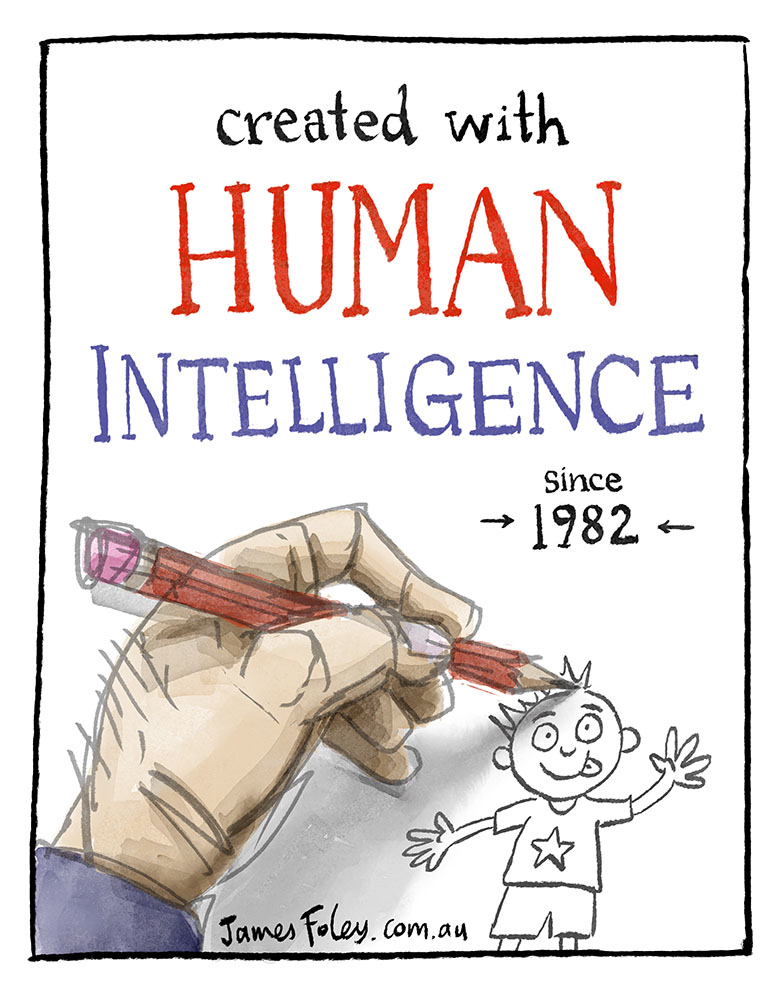
I’ve never used generative AI for any of my books, and I don’t plan on ever doing so. Why would I deprive myself of the fun and the challenge of making something from scratch?
Beth’s positive, community-centred logo was just what I needed to see this week; like me, you may have noticed the recent, rapid rise of generative AI across the creative industries. Writing, art, film and music have all been affected.
As just one example, the number one song in Australia for the past four weeks – a cover version of Madonna’s Like A Virgin – uses an artificially generated singer. This was not disclosed until investigative journalism and public backlash forced the cover’s ‘creator’ to add AI credits to the song on Spotify.
My facebook feed has also been awash with generic AI-generated, self-published picture books. People who can’t (or won’t) draw, and can’t (or won’t) pay for an illustrator, are producing books full of characters with wonky eye contact, stiff body language and a distinct lack of soul.
A school I visited recently was excited to show me the picture books that their year 6s had written and illustrated for their year 2s. However the images were entirely generated by AI as they ‘only had two weeks to complete the books’. I would argue that this was enough time to draw pictures for a picture book. I would add that the decision to use generative AI deprived the students of an opportunity to learn and grow. Did the teachers inform the students that generative AI is built on stolen art? Or did they omit that from their lessons? (Or were the teachers completely unaware of this fact?)
I recently came across a new Australian picture book press that is open about its use of generative AI in its illustration. The press’ website claims that “there is still room, in a world of fast publishing, for books made the old way: slowly, deliberately, by one pair of hands”. This short sentence is wildly misleading because:
- mainstream publishing is notorious for being the opposite of fast;
- using generative AI is not ‘the old way’;
- mainstream publishing has always involved more than one pair of hands (writer, illustrator, editor, designer, printer, marketer, distributor, bookseller, librarian, reader, to name a few);
- typing prompts into chatGPT does not constitute making things by hand; and
- generative AI is built off the stolen work of millions of creatives, so is emphatically not the work of ‘one pair of hands’.
It’s almost as if the text on the press’ website was not written by a human being who could think things through logically to ensure they made sense, but was instead simply pooped from the butt of generative AI.
I’m not against AI in all contexts. So-called ‘traditional AI’ models (i.e. non-creative algorithms that analyse data) are starting to help in detecting and fighting cancers; can be used to assist people with disabilities; and can provide us with better models for predicting extreme weather events. These are all wonderful benefits to humanity.
However, generative AI is different. It’s the kind of AI that is trained on the stolen creative work of millions of people without their consent. It’s powered by data centres that use immense amounts of electricity and water, and produce extra e-waste – thus accelerating environmental problems. It’s the kind that tells you what you want to hear so that you keep using it, and has inadvertently assisted several people with ending their own lives.
And apart from these serious and disastrous effects, it has the added impact of disconnecting us from our creativity, and thus our humanity. I don’t mean that in some airy-fairy woo-woo way. I mean it quite literally; enduring the creative process is an integral part of being human, and generative AI deprives us of the struggle, the failure, and the psychological and emotional growth that comes from trying to make something from scratch. ‘Creativity’ at the touch of a button isn’t creativity at all.
It seems the only benefit of generative AI is money … for some. If people don’t have to pay artists, then they save money. If techbros can survive the genAI economic bubble, then maybe they’ll have billions of dollars waiting for them on the other side.
it is encouraging to hear that the Australian government has pledged to protect the copyright of creators and stand up to the AI companies. Prime Minister Anthony Albanese said in a recent speech that:
“An artist’s creative endeavour is their work and their property. No company should use Australian books, music, art or news to build or train AI without the artist’s control. That includes the artist’s control of the price and value of their work. Anything less, is theft.“
We are yet to see how this is going to work in practice; but many creatives (including me) are hopeful it is a step in the right direction.
In the meantime, please support your local creatives – the writers, poets, artists, filmmakers and musicians whose works have been taken without permission to train generative AI. All Communities need art; REAL, human-made art.
And why not engage your own creativity? Take a class. Make a mess, make marks, make words, make music – make art! Your mental health will thank you for it.
Humans have been making things since we started being humans. Why would you give up creativity – an immensely satisfying part of being alive – and let a chatbot and its tech bro overlords make things for you instead?
 James Foley